What the Wwft asks of a real estate agent
Anyone who professionally mediates in the purchase or sale of real estate falls under the Wwft, the Dutch anti-money laundering act. For rentals, the law applies to the intermediary only from a rent of 10,000 euros a month. Since 1 January 2026, real estate agents are supervised by the Dienst Financieel-Economische Integriteit (DFEI) of the Ministry of Finance, the successor to the Belastingdienst's Bureau Toezicht Wwft.
The core is client due diligence. You do it for every assignment, before the business relationship starts. According to the supervisor it also covers the counterparty: the party your client signs an agreement with through you. If you cannot complete the due diligence, you may not take the assignment.
Per assignment: client due diligence
- The client is identified: name, date of birth and address are recorded.
- The identity is verified with an identity document; type, number, date and place of issue are recorded.
- Anyone acting for the client is authorised to do so and is identified too.
- For a company: there is an extract from the trade register and you checked that the UBOs are registered.
- The UBOs are identified and the ownership and control structure is clear.
- The purpose and intended nature of the assignment are recorded.
- You checked whether the client or a UBO is a politically exposed person (PEP).
- For a PEP: someone in senior management gave consent and the source of wealth and funds is established.
- The names are checked against the sanctions lists.
- The risk of this client is assessed and the decision is in the file with a reason and a date.
- The counterparty is checked, or you recorded who did it.
During and after the assignment
- Does what you see still fit the client's profile? If not, the due diligence is done again.
- An unusual transaction is reported to FIU-Nederland at once, without the client knowing.
- The report and the FIU's confirmation of receipt are in the file.
- The records are kept until five years after the business relationship ends.
For the agency
- The agency's risk assessment is recorded and up to date.
- Policy and procedures are approved by management.
- With two or more people running the agency, one of them is responsible for compliance.
- Staff follow Wwft training periodically, and it is recorded.
How the Wwft check in Buyerbase works
Buyerbase supports this work, but it does not make your agency compliant by itself. It collects the details, runs the checks and records everything.
Start the check
From the client's record; for a buyer once they are in Uploading documents. The client gets a link by email and a task in the portal. A person buying together with them gets their own link.
The client fills it in
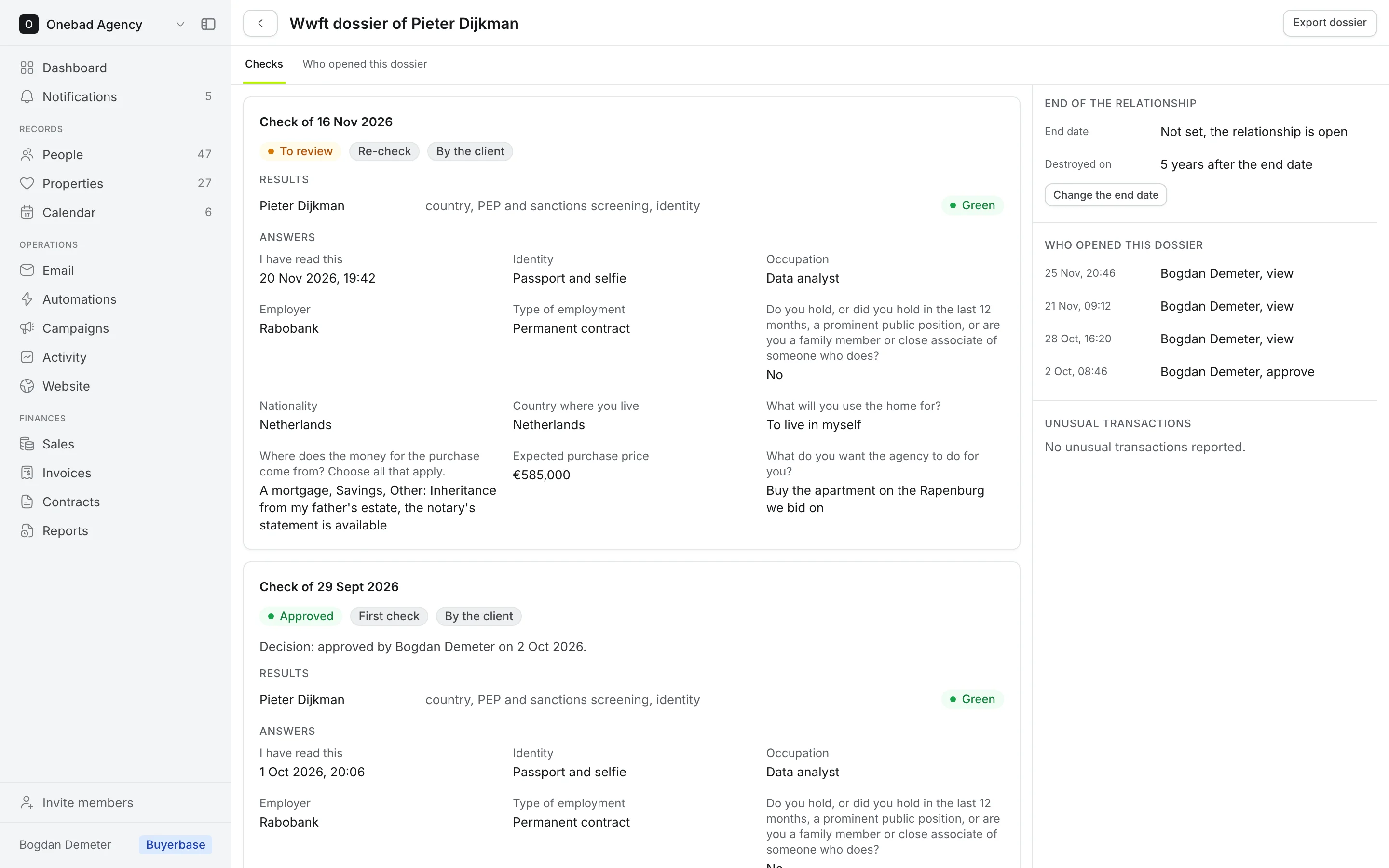
Identity with a passport or ID card and a selfie, then questions about occupation, a public position, the use of the home and where the money comes from. A company also names its owners and uploads the UBO extract. If it cannot be done online, you fill it in.
The checks run
PEP screening with family members and close associates, the EU and Dutch sanctions lists, identity, countries and, for a company, the KVK. Each person and company comes back green, amber or red, with the reasons.
You decide
An agent approves green. Amber, red and every company go to an owner or admin, who approves or refuses with a reason. On approval the linked contract goes out for signing; a refused client moves to Refused.
The file stays current
Every round stays with decision, answers, files and who opened the dossier. Every open dossier is screened again each month; a new name, a new address or a new deal after more than 12 months calls for a new check.
Until the check is approved, the client goes no further in the pipeline. A buyer stays in Uploading documents until the contract is signed too; a seller or landlord does not move into Meeting, a tenant not into Documents.
What the agency keeps track of
- On the Wwft page in Settings you name a compliance officer, upload your risk assessment with a reminder after a year, and record who followed which training.
- Any member can flag an unusual transaction; it goes to the compliance officer. Your agency files the report with FIU-Nederland itself.
- When you act for a buyer, you record how the seller was checked: with the selling agent's client data, or through the notary.
- You export one dossier, or all dossiers at once for the supervisor.
A Wwft check is billed per client checked, at what the identity and screening services cost, with no margin.
This article is not legal advice. If you are unsure about a client or a report, read the supervisor's guidance or ask an adviser.
More on thisWwft checks in BuyerbaseThe portalThe client portal, where your client fills in the checkSources
- Dutch Anti-Money Laundering and Anti-Terrorist Financing Act (Wwft), articles 1a, 1d, 2b to 2d, 3 to 5, 8, 16, 33 and 35, wetten.overheid.nl
- Belastingdienst: professions under the Wwft, real estate agents and intermediaries (in Dutch)
- Belastingdienst: from 1 January 2026, BTWwft and BEH become the Dienst Financieel-Economische Integriteit (DFEI) (in Dutch)
- FIU-Nederland: reporting group real estate agents (in Dutch)
- Government of the Netherlands: national sanctions list terrorism (in Dutch)
- Belastingdienst: obligations under the Wwft (in Dutch)